random reviews, recollections & reminiscings

Showing posts with label Eastwood. Show all posts

Sunday, December 14, 2008

REEL REVIEW: Gran Torino (2008) ****


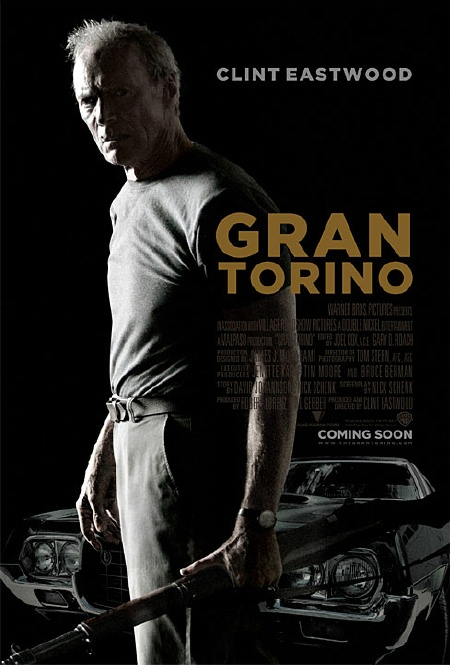
Gran Torino (2008) poster


written by: Nick Schenk (screenplay/story) & Dave Johannson

produced & directed by: Clint Eastwood


rated R (for language throughout and some violence)
1 hr. 56 min.


If it wasn't for iconic characters like The Man With No Name and Dirty Harry, there would be no way to take Clint Eastwood's latest acting role seriously. One of the more resonating characteristics of these gun-toting, take-no-crap personas is the way in which they resolve their problems with a blast of gunfire and a resoluting wisecrack, while walking away without a second thought. Many of us wish at times that we could get away with that behavior, so does racist Korean War vet, Walt Kowalski. Retired after 50 years from the local Detroit Ford plant and recently widowed, Walt grumbles and growls his days away as he nurses his perfectly-manicured postage stamp of a lawn in his well-maintained, picket-white fenced home.

Walt is that old goat who looks around at his world and wonders how things have gotten the way they are. His selfish and chubby Midwest sons, busy with their careers, have alienated themselves (most likely due to his cold gruffness) as they plot out how to get Walt into a senior home. He groans at his grandkids with their piercings and blackberrys but also at the persistant Father Janovich (Christopher Carley) from his wife's church. Walt doesn't care for the baby-faced padre who promised his wife that he'd get him to confession. It would seem Walt cares only for a handful of things at this stage in his life: his Lab retriever Daisy, his M1 rifle from the war, and his mint condition 1972 Gran Torino, a symbol of days long gone. Walt finds himself as lost and without a place as the company he used to work for.

What gets under Walt's skin the most though is the noticeable influx of Asian Hmong immigrants he finds himself surrounded by in what used to be a blue-collared neighborhood. No country for this old man, indeed! Eastwood plays up Walt's disdain to the hilt but we can't despise him because we realize he's cut from a different time period. While there's no excuse for his abrasive racism, you can't help but respect who he is and that's a tribute to the actor who's playin' this worn-down character. With all this build up, it's obvious that Walt is destined to get a serious thawing.

That comes in the form of the neighbor teen, Tao (Bee Vang) who tries to steal Walt's beloved vehicle in a gang initiation stunt. He thwarts the freshman thief but this encounter just catapults the inevitable. The botched theft is what brings a livid Walt rifle-first into the Hmong neighbors as he winds up breaking up a gang fight on his front lawn. Inadvertantly scaring off the gangbangers, Walt unintentionally winds up saving Tao and his family from further violence. All he wanted was them to stay off his well-kept lawn. What follows is an outpouring of gratitiude from the Hmong family and as punishment for his actions, Tao is made to work for Walt (though it's unclear who this is punishment for) in order to restore honor to the family.

Tao's older, plucky sister, Sue (Ahney Her) starts to wear down Walt's calcified heart as she becomes his introduction to her family which finds him coming to terms with the Hmong culture. Through his encounters with the various generations, he starts to see that he is a haunted man, empty and without peace. A man who hides behind any racial epithet possible without any possibility of anyone really getting to know who he is. Walt is soon won over by Hmong traditions, befriending Thao with hopes to teach him some self-respect before the gang activity worsens. But he sees there isn't much hope or future for Tao and his family and is compelled to intervene, driving away local gang members and earning the respect of the Hmong community.
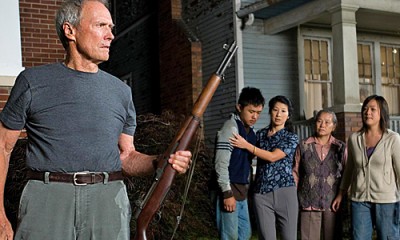
For Walt, defending the defenseless is a form of atonement and an act of contrition. The killings in Korea still effect him, as he tells Tao, "I used to stash guys like you five fet high in Korea. Used 'em for sandbags," which only confirms that some resolve is needed. He now has a reason to do away with his bitterness and protect these kids against anyone who would do them harm. Yet unlike the typical Eastwood vengeance flick we're used to, this is as much in line with Will Munny (from "Unforgiven") in that there is a price one must pay when violence is used. Esatwood knows it would be plain stupid at his age to have Walt decimate the gangs in the hood. Instead, we're given an emotional resonance that becomes enthematic for the entire film. There's a final validation here for Walt which gives the viewer a rewarding cinematic experience.

Eastwood successfully culminates all the tough-guy characters he's known for into Walt Kowalski, an incorrigible soul who has to deal with issues of life, death, racism and salvation. While it may not be his best performance it certainly is one of his more ballsy ones. Is it a perfect script? No, not really. Are there flaws? Some. It's not a scholastic take on race relations, but newcomer Schnek understands the venomous mentality of men like Walt, who live and breathe outdated American values, only to find their faith rewarded by the degeneration of respect in the youth and the rise of foreign perspectives in their own backyard. I appreciated the fact that Eastwood used primarily first-time Hmong and Asian actors. It lended an added authenticity and naturalness to the characters that at time is jarringly noticeable but a welcome surprise nonetheless.

Like many of his smaller films (Million Dollar Baby) there's an exacted simplicity that is to be commended here. An easy-going yet purposeful filmmaking style that is long gone. At 78 years, Clint has no peer. No one else can do what he does, making him the best there is at what he does. If this is to be Eastwood's swan song as an actor (gasp!) then this is quite appropriate. For anyone who enjoys Clint's acting, his humor, his honesty and craftsmanship as a director....this is a must see.


Gran Torino Poster


The Skinny:


  • The film will see a limited release in the States on December 12th and 17th and then a wider release on January 9th, 2009.
  • Filmmakers chose to produce the film in the state of Michigan, being one of the first films to take advantage of the state's new law that provided lucrative incentive packages to film productions.
  • Filming began in July 2008; locations included Warren, Royal Oak, and Grosse Pointe Park, with work on the final cut endint in late October 2008.
  • Hmong crew, production assistants, consultants and extras were used.
  • There has been debate over the film's depiction of Hmong gang culture, with some criticizing its authenticity and fearing that the film will perpetuate stereotypes of Asian youths.
  • Eastwood described the character's relationship with his two prized objects (the Gran Torino and M1 rifle, "He worked on the line in the Ford plant and retired and had this one car he bought himself. It's sort of a symbol of his days with the Ford plant. The M-1 is sort of a symbol of his days in the military... He's clinging to the memory of the war. You'll find out when you see it, some of (the memories) are not as pleasant as others. That helps make him even tougher to get along with."
  • Of the character, Eastwood said, "He's one of these guys who finds it very hard to accept change... [and that the film] just shows how his life goes and how he gets involved with the Hmong people who are living next door."
  • Eastwood's starring role was his first since Million Dollar Baby in 2004.
  • The character of Tao is Van's first acting role and is described as "the neighborhood wimp", and the large height difference between Tao and Kowalski was a deliberate echo of the mentor relationship Kowalski has to the character. Vang said, "Tao is literally 'looking up' to [him]".
  • Open casting calls for Hmong actors were held in Hmong communities in Saint Paul, Fresno and Detroit. All but one of the ten Hmong leads were acting in a film for the first time, as were many of the Hmong extras.
  • Eastwood's son, Scott (son of flight attendant Kathryn Reeves) plays a spineless thug named Trey in a hilarious scene where Walt defends Sure from some African-American thugs.
  • For authenticity, Eastwood encouraged ad-libbing among the actors in the Hmong language. An authentic Hmong shaman was cast, though it was claimed his ceremonial scenes were made more exotic.
  • Eastwood has win Best Actor recently at the National Board of Review Awards.
  • Eastwood often composes music for his films and this one is no different. This time he actually sings a little of the theme song, Gran Torino, that can be heard in the final scenes.
  • He wrote the song, which is nominated for a Golden Globe, with his son, Kyle, Michael Stevens and singer, Jamie Cullum (who can be heard singing in at the end credits).


Eastwood talks cars and Gran Torino


Wednesday, February 7, 2007

REEL REVIEW: Letters from Iwo Jima (2006) ****

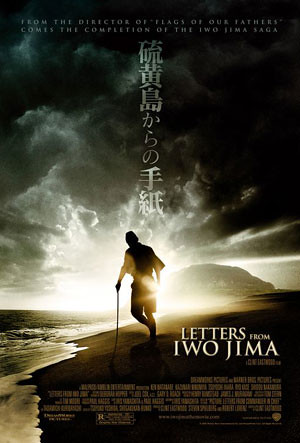
Letters from Iwo Jima (2006) poster


R for graphic war violence.
2 hrs. 21 min.

written by: Iris Yamashita & Paul Haggis
produced by: Clint Eastwood, Robert Lorenz & Steven Spielberg
directed by: Clint Eastwood


"The life of your father is just like a lamp before the wind."

- a line from a letter written by Lt. Kuribayashi to his son, Taro from Iwo Jima


The only thing I knew about the battle for the occupation of the island of Iwo Jima was the random iconic photograph taken by the late Joe Rosenthal. You know the one. Five American soldiers raised a U.S. flag atop Mount Suribachi on February 24 1945, four days after Marines had landed on the Japanese volcanic island. The black & white photograph showed an assured American history or at least as much as a victory can be portrayed through one photograph. But who were those soldiers lifting that flag and who were the soldiers that defended that island?

These two questions are answered in director Clint Eastwood's two recent films. The first film, "Flags of our Fathers" was released in the U.S. on October 20, 2006 and despite getting decent reviews, did not draw too many people. While "Flags" deals with the lives of the three surviving soldiers from that infamous photo and the media frenzy that followed, "Letters from Iwo Jima" (released in Japan on December 9th and in the U.S. on January 12th) is the story of those unseen Japanese soldiers that tried to hold their land so the Allied forces would not turn it into a base from which they could attack their homeland. The title of the film is derived from the source and inspiration for the story. While making "Flags", Eastwood found out about the piles of unread letters that were discovered by Japanese archivists buried in the caves the soldiers had burrowed in the mountainside. These letters turn out to be the actual framework for this little-known epic.

The best way to handle a war movie is to pick a character or two and take the audience on the same revealing journey as the grim realities of war unfold before them. Eastwood succeeds in doing just that while evoking real emotion at the same time. Although every camera ankle and color saturation is deliberate, no emotional heart-tugging is forced here. The viewer isn't forced to feel for these soldiers or their situation by some syrupy scene or dialogue, but rather the overall poetic delivery of the mood and of the soldiers vivid memories as they write their letters.

The story begins with a young soldier named Saigo (Kazunari Ninomiya), a private in the Imperial Japanese Army, begrudgingly digging trenches on the beach; as far as he is concerned, the Americans can have the island. He's a baker who was forced to leave his wife and unborn child to go to Iwo Jima, he can't see the point in defending a lonely rock so far from home. At the same time, Lt. General Tadamichi Kuribayashi (Ken Watanabe) flies to Iwo Jima via camouflaged plane and meets the other commanders. He sets out on foot with his aide to study the island firsthand and come up with a plan to defend the island against the American invasion. At the same time, the American fleet, stationed at Saipan, is preparing to go north to Iwo Jima. Although there are other characters focused upon, these two soldiers on opposite ends of the ranking scale, have the most interesting, most relatable stories to tell.


When Kuribayashi arrives on the beach, notices his soldiers digging trenches on the beach and orders them to stop; instead, he tells them to burrow fortifications in the higher grounds. He sees Saigo being beaten by his superior officer for uttering unpatriotic statements. He stops the beating, establishing a connection between himself and the lowest man in his ranks and starting a pattern for their future encounters. Saigo is saddled with a duty he didn't ask for, and the General sees it as his counter duty to make sure he gets as many of his men off of Iwo Jima alive as possible. This doesn't sit well with most of the other officers in his employ, who would rather see everyone die with honor than retreat. They don't see the value of living to fight another day.


Ken Watanabe as General Kuribayashi in Warner Bros. Pictures' Letters From Iwo Jima


Characterization is one of the many aspects of this film that was quite refreshing to me. Kuribayashi is portrayed as a man who leads with a quiet, gentle force that is not respected right away by his fellow officers but we see it and so do the lower ranking runts under him. He sees his men as men, not just single-minded, suicide soldiers. We see a lamenting heart as he writes his letters to his son on the mainland telling him of their dire conditions. One of stand-out characters was Officer Nishi (Tsuyoshi Ihara), a tank commander and equestrian Olympic Gold Medalist from the 1932 Los Angeles Olympics. He's and old friend of Kuribayashi and one of his only confidants. Nishi tells him that the prospect of Imperial Japanese Navy sending support and helping them defend the island is pretty bleak seeing that the Japanese Combined Fleet was destroyed at the Battle of Saipan. Upon hearing this, Kuribayashi reflects on his plan to defend Iwo Jima with no outside support, and soon comes to the conclusion that Iwo Jima will be defended until the death.

The rest of the story deals with the varying actions of these soldiers who know they are left for dead on this island. Some soldiers accept their fate and make the difficult decision that it is better to commit suicide then suffer the shame of defeat. Others fight to the death instead of taking their own lives as a more noble way of going out. With either outcome, we see the pressure of war thrust upon these men as a couple of them even opt to surrender. This is the first World War II film that I've seen where the Japanese are depicted as human instead of one-dimensional. There are the old Bugs Bunny cartoons and John Wayne war movies that depict the Japanese as frothing mad kamikaze nutjobs but here we see they have the same fears, doubts, courage and heartbreak as anyone else.


Tsuyoshi Ihara as Baron Nishi in Warner Bros. Pictures' Letters From Iwo Jima

One of my favorite scenes is when Nishi and his troops take in a wounded American soldier. His troops are apprehensive at first due to their dwindling medical supplies. Nishi orders them to take care of him, to treat his wounds and tend to him. Despite their efforts, the American dies, and he eulogizes him by reading a letter the American received from his mother. It's a moving moment as all of the soldiers within earshot slowly pay closer attention to the loving and comforting words of this enemy's mother. They realize that this soldier is not so unlike themselves. He too is loved and is thought of by someone far far away and maybe this is how they will look one day....dead with their loved ones off in the distance somewhere wondering when they'll return. It's scenes like this, shot simply, that are effective without getting overly sentimental.

The talented cast of this film is made up almost entirely of Japanese actors speaking in their native tongue. I'm not gonna go into the specifics of what great actor portrayed which great character here because, although these minor characters are integral, not all of them are as fleshed out and crucial to the story as the two main characters the screenwriters focus on. We do see some of the American soldiers, but the interactions between the two sides on a one-on-one level are limited. None of these soldiers are characters from "Flags", and I applaud Eastwood for avoiding any cameos or convenient crossovers that coulda been done. After all, It woulda been a lil too jarring to see Ryan Phillipe whiz by, taking the viewer outta the film's perspective.

Watanabe is a remarkable screen presence. He reminds me of a classic matinee idol, and Eastwood has made up for Hollywood's indiscretions toward this fine actor by handing him the meatiest role of the movie. His Kuribayashi is an intelligent leader who sees value in strategic planning only if the human factor is given the utmost importance. The story shows how he spent some time in America which make some comrades suspicious, it actually gives him greater insight into what he is up against. Watanabe gives the character the warmth and gravitas with equal measure. The film shows the Kuribayashi doodling in a sketchpad while bombs drop all around, shaking the walls of the underground tunnels the Japanese are holed up in, and it's actually this picture journal that forms the basis of first-time screenwriter Iris Yamashita's script.


Kazunari Ninomiya as Saigo in Warner Bros. Pictures' Letters From Iwo Jima


Perhaps to match the subject matter, Eastwood has given the film a gray, almost sepia tint. The air around everyone looks as if it is heavy with clouds, and it makes it impossible to forget the fate that hangs over them. Yet, the movie never grows so heavy that it buckles under its own furrowed brow. This is because the director, like the General whose story he is telling, never forgets that his movie is about real people. Sure, it's a war movie with plenty of fighting, often with very gory results, but Eastwood makes sure he has time to show quiet character-building moments that matter. Like Kuribayashi sharing a drink with a sympathetic ally Nishi and Saigo swapping stories with his buddies, and even the soldiers laughing and speculating on the strange behavior of their superiors. These scenes break any preconceived stereotype we might have, not just of the Japanese soldiers but of WWII in general. No longer is it possible to portray it as a simplistic conflict where the good side was very, very good and the bad side so very, very bad. Rather, war is complex, dirty, and for the men who do the fighting, it rarely has the clear outcome history memorializes.

By stepping out of the normal boundaries of a WWII movie, Eastwood has found something new to say on the subject. For those out there who ask why we need another movie about the conflict....see this movie. It proves there is still much we have to learn, still stories that haven't been told. That it's done so well and by one of the finest and most daring filmmakers we have is just a bonus.


Either of Eastwood's films can be seen on its own without watching the other. I plan on finally seeing "Flags" when it comes out this week in a bare-bones DVD (I'm sure a special edition will come out once this film, up for a Best Picture Oscar, is released). You'd think cuz I was an extra in "Flags" I woulda got free tiks, but, ah well. But, I have a feelin' "Flags" may suffer a lil in my eventual review because I can certainly attest that this film is a masterpiece. I dunno how many people are wanting to see this movie, I'm hoping everyone cuz that's who I'd recommend it to. This harrowing "other side of the story" not only honors the memory of these soldiers but manages to see beyond any genre as it gives a quiet intimacy and beauty to a grim and bloody battle.


The Skinny:


  • The film was originally entitled "Red Sun, Black Sand."
  • Although the film is set in Japan, it was filmed primarily in Barstow and Bakersfield in California. Filming in California wrapped on April 8, and the cast and crew then headed back to the studio for more scenes before a quick 1-day trip to Iwo Jima for some on location shots. The Japan Maritime Self-Defense Force (JMSDF) operates a naval air base in the island, which is used by the United States Navy for operations such as nighttime carrier landing practice. Civilian access to the island is restricted to those attending memorial services for American and Japanese fallen soldiers. The location was used under a special permission from the Tokyo Metropolitan Government.
  • Filming finally wrapped in late 2006.
  • Kazunari Ninomiya (Saigo) is better known as a pop music star, part of the group Arashi. Letters is only his fourth motion picture and the first aimed at an international audience.
  • Although they were filmed back to back, none of the cast from this film appears in "Flags of Our Fathers", and vice versa. None of the cast members even met each other from each film. The only cast member to be in both films comes in the flame throwing figure of Chuck Lindberg (Allasandro Maestrobuono). He advances on a bunker with a flamethrower. The members of the casts of both films have met, though never officially presented together, as there many commonalities between the casts in the acting community.
  • Watanabe read actual letters sent by Imperial Japanese Army Gen. Tadamichi Kuribayashi to his family from Iwo Jima while preparing for his role. Eastwood has always surrounded himself with the same talented and resourceful film crew in his film directing. He has kept the same cinematogrpaher (Tom Stern), editors (Joel Cox & Gary Roach), production designer (Henry Bumstead), and casting director (Phyllis Huffman). This would be the last film Eastwood would work on with Bumstead (died on May 24, 2006) and Huffman (died on March, 2, 2006).

About Me

My photo
Believer. Brother. Son. Nephew. Cousin. Friend. Husband. Father. Colleague. Student. Teacher. Illustrator. Actor. Director. Singer. Improviser. Listener. Observer. Passenger. Driver. Tourist. Traveller. Imaginative. Resilient.