random reviews, recollections & reminiscings

Monday, July 23, 2007

REEL REVIEW: Once ****

R (for language)
1 hr. 28 min.
written & directed by: John Carney
produced by: Martina Niland
I've been wanting to see this movie since it's release. Actually, I've been in a hurry to see this movie since it's release cuz I know that despite rave reviews, movies about "guy meets girl" usually have limited and short releases. What attracted me? I heard it was about an Irish singer-songwriter/guitarist (the "guy") with emotional baggage who meets a struggling Czech flower seller/musician (the "girl") while performing on a Dublin street. The two discover they are kindred spirits through their music and much more. With that premise, I was sold. I heard that the music was incredible too but most of all it's just hard to find a realistic love story in cinema lately.
This is a love story with real characters in it. There's nothing entirely cinematic about these characters, these are just ordinary people you might see or meet anywhere. No insanely, knock-out gorgeous people here. No Jessica Biel falling for Adam Sandler antics goin' on here. The movie benefits from that premise (and promise) and as well as a documentary, hand-held camera feel with an obviously extremely low budget. There is pure intentions here at the film's heart and a creative passion for musicianship, which is perfect because if there was anything added the film would just come across as rather pretentious.
The Guy (Glen Hansard) is a working-class Irish dreamer, plugging away in his father's vacuum repair shop by day and hitting the streets to perform his songs at night. During one of his street corner concerts, Guy meets The Girl (Marketa Irglova), who is smitten with Guy's guitar playing and touched by his lyrics. After some flirtatious pushing and pulling, Guy asks Girl to form a makeshift band, fashioning a tentative bond between the two that skirts around love, but never seems to settle, much to Guy's frustrations and heartache.
What really sold me on "Once" were the intimate moments between the characters. It just all seemed so real and I cannot think of anything else to describe it....just real. You can tell there was little getting in the way of this film, no studio interference whatsoever is felt here. The end product being a soft, trembling feature that believes in the magic of infatuation and silent agony of unrequited and uncertain love. It's an open wound of stifled emotions, and I was quite taken with the interesting ways it attempts to portray the unstoppable connection between man and woman, here employing the rickety wood bridge of music.
Glen Hansard and Marketa Irglova in Fox Searchlight's Once
Hansard's (lead singer of the Irish band The Frames) only other noticeably role was that of a guitarist in 1991's "The Commitments" which is actually to his benefit. It's much more effective to have an unnoticeable actor perform in this role and Hansard being a musician it helps the passion and reality of the character and storytelling. I was blown away with this being Irglova's debut acting role. Just amazing! She responds to those around her naturally and has an astute listening ear. Both actor's performances add a certain freedom to the film. It's obvious that director John Carney likes to rely on the freshness of the talent, trusting their unease with acting will bring out the kindly awkwardness between the characters. This technique works; slowly sucking in the viewer as the two grow more comfortable around each other, especially when they create music. I'll go ahead and say that some may not like Hansard's songwriting or musical delivery. I loved it but then again I'm a big fan of acoustic singer-songwriter work.
Regardless of a viewer's opinions of the music, the passion behind the tunes cannot be denied and speaks volumes about the characters. It really is impossible to turn a cold shoulder to the romantic pining blossoming between the characters when they combine their voices, edging "Once" closer to the musical genre at times. Many have said that this film plays like a modern musical but for me the music is just another star, and inevitable player that progresses the story instead of stopping the story for mere exposition. There is character and story growth while the music is played, it's not just video montage fluff. Does the movie have a happy ending? Let's just say it has a real ending and the "happy" is seen in the realism portrayed throughout the movie.
Marketa Irglova and Glen Hansard in Fox Searchlight's Once
My wife was a lil off-put by some of the dizzying hand-held type camera work but other than that she really loved it. It almost feels unfair or reaching to call out the technical limitations of the film when it really is so sweet and humble. Apparently, it was shot with a commercial DV camera, therefore all the jittery long lenses and camouflaged camera placement to brings that raw, unfettered look at two souls finding perfect sync. Admittedly, it keeps the film baggy; free from succumbing to the pressures of the meet cute and assorted romantic nonsense. Carney may be victim of becoming a lil too enamored by the cinematographic limitations, and it's possibly he loses some excruciatingly important scenes to darkness and lousy focus. But, that's nit-picky to the overall package. I don't really need to see all the moments of emotional longing and heartache, as long as I can feel it.
I liked the quiet moments in this film just as much as the musical scenes.
There's a moment shared between Guy and his father (Bill Hodnett) where they sit in a cramped kitchen and listen peacefully to Guy's demo. Because the character of his father has only been developed slightly, we don't really know what his reaction to the demo will be. His father has already been seen as kind and quiet but he seemed to have a permanent frown on his face. But his reaction is one of subtle sweetness, and it sums up the movie beautifully. This is a warm picture intended for soft hearts who appreciate the ache of attraction. I loved it and consider it my Top 10 of 2007 already. It's too bad it's a movie that will most likely be hard to find in your area theaters. If you're looking for a film to movie you, there's an exceptionally sincere, expressive quality here that is universally appealing.


The Skinny:
  • Neither of the two leads is a trained or experienced actor; Hansard and Irglová are both professional musicians.
  • During the filming of the opening scene, because the scene was shot with long lenses placing the crew far away, and without informing the public, who would be crossing through the scene, a bystander attempting to be a hero accidentally injured the thief as he was running away by kneeing him in the groin.
  • The director and cast were suffering from "South Park" withdrawal during filming and thus one of the characters, a session musician, was named "Timmy" - this is obvious as they depart the studio.
  • The "look" of Dublin in the film is a call-back to John Carney's and Glen Hansard's recollection of Dublin 10-15 years prior to the film's making - a more working class city.
  • Carney was previously a member of The Frames, the band led by Hansard.
  • The story is partially autobiographical as Carney lived in Dublin and maintained a long distance relationship with his girlfriend living in London.
  • The flashback footage of Guy's girlfriend is actually that of director Carney's girlfriend.
  • Hansard's mother plays a cameo as one of the singers during the party.
  • There is a moment when the guy asks the girl whether she loves her husband. She responds, "No. I love you." However, her response is in unsubtitled Czech, so the man does not understand her - nor do audience members who don't know the language.
  • Director Carney, former bassist for Hansard's band The Frames, had asked his long-time friend to share busker anecdotes and compose songs for the film, but had intended the male lead to be played by actor Cillian Murphy, who was an almost-signed rock musician before turning to acting. Murphy was also going to be one of the film's producers. But Murphy supposedly balked at acting opposite non-actor Irglová (then 17 years old) and at singing Hansard's octave-leaping songs, so he pulled out, as did the film's other producers along with their financial resources.
  • Carney turned to songwriter Hansard, who'd previously done only one acting job, a supporting role as guitarist Outspan Foster in the 1991 ensemble film "The Commitments", the story of a Dublin soul music cover band.
  • Hansard was initially reluctant, fearing that he wouldn't be able to pull it off, but after stipulating that he had to be fully involved in the filmmaking process and that it be low-budget and intimate, he agreed. "Though I was initially thinking of using a good actor who could half sing, I quickly realized I should do it the other way around and get a good singer who could half act," Carney said in a Chicago interview.
  • Produced with a shoestring budget of only $150,000 USD, funded by the Irish Film Board, the film was shot with a skeleton crew. Money was saved by shooting the party scene in Hansard's flat, with his personal friends playing the partygoers/musicians.
  • The Dublin street scenes were done without permits and with a long lens so that many passersby didn't even realize that a film was being made. The long lens also helped the non-professional actors relax and forget about the camera, and some of the dialogue ended up being improvised.
  • Hansard and Irglova became a couple in real life, either during filming or later while on a promotional tour across North America. Entertainment Weekly reported,
“
The chemistry between (the) two leads ... was easy to produce during the January 2006 shoot in Dublin. "I had been falling in love with her for a long time, but I kept telling myself she's just a kid," says Hansard, 37, who has known his 19-year-old costar for the past six years. (The two are now dating.) "There was definitely the feeling we were documenting something precious and private."
”
  • Yet the real-life couple was quite happy with the unrequited ending for their onscreen characters. In an interview, Hansard states that "Had Fox Searchlight Pictures changed it, had they changed the end and made us kiss, I wouldn't be interested in coming and promoting it, at all."
  • The film has achieved major acclaim, receiving the World Cinema Audience Award for a dramatic film at the 2007 Sundance Film Festival.
  • On the May 18, 2007 broadcast of Ebert & Roeper, both Richard Roeper and guest critic Michael Phillips of the Chicago Tribune gave enthusiastic reviews. Phillips called it, "the most charming thing I've seen all year," "the Brief Encounter for the 21st century," and his favorite music film since 1984's Stop Making Sense. Roeper referred to the film's recording studio scene as "more inspirational and uplifting than almost any number of Dreamgirls or Chicago or any of those multi-zillion dollar musical showstopping films. In its own way, it will blow you away."




Wednesday, June 13, 2007

A Good Year (2006) ***1/2

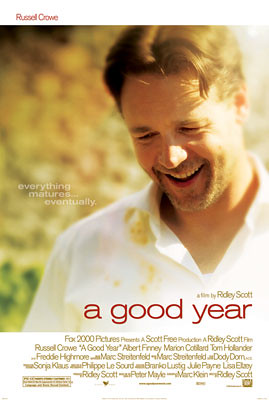
A Good Year (2006)

PG-13 (for language and some sexual content)
1 hr. 58 min.

written by: Mark Klein, Nick Griffin, Ted Griffin (from Peter Mayle's book)
produced by: Erin Upson & Ridley Scott
directed by: Ridley Scott


Ridley Scott is a director known for not only telling great stories but for also creating a tapestry of color in which to tell these stories. Whether the genre be sci-fi or drama, his films always look amazing to me. He's got a devastating capacity to craft beauty within truly treacherous scenarios. The man's visually crisp eye can make crashed helicopters, gothic Roman duels, and futuristic dilapidations striking enough to adorn walls as art. Spilling emotion amidst spilling blood is second nature from this weathered director. In his latest film he displays a beautiful scenic locale and a touching story filled with compassion, reflection and awakenings. Added to the mix is his mainstay player Russell Crowe as a nostalgic businessman who is slowly thawing emotionally and thus surfaces this film, based on a best-selling book, which turns out to be a surprise delight into the winding
French vineyards of Provence.

Max Skinner (Russell Crowe) works with fiscal numbers, "lab rat" sales associates, and tremendous amounts of capital inflow. He's comes across as cold, detached and myopic cuz quite frankly, he is. His personal assistant, Gemma (Archie Panjabi) keeps him updated with everything in his life be it business or personal cuz he just doesn't want to be bothered. Atop his social pipeline in beautiful industrial London, this bachelor has ensnared everything (and everyone) he could tangibly want by embracing his apathetic, cold persona. Perfectly aware of himself, Max achieves greatness without a true sense of charisma or anyone close to share in his success. But, he wasn't always like this....


Albert Finney and Freddie Highmore in 20th Century Fox's A Good Year


Yes, London's popular fiscal shark has a much warmer past, however. An echo of previous delight as a young boy begins to flicker as a letter arrives notifying him of his late Uncle Henry's (Albert Finney) passing. His uncle looked after young Max (Freddie Highmore) on his winding Provencal vineyards in France during his youthful summers, teaching him the simple pleasures of whimsical living, gracious defeat, and fruits of the earth. Without much warning, Max has the past dropped in his lap as he discovers his lineage as the sole blood relative and inheritor of the wondrous vineyard.

Suddenly, his harsh, satisfying life scrapes to a halt as he schedules a rapid sign-and-sell procedure in Provence for the estate. Once he arrives, all of the countryside's striking scenery ensnare Max once again and he is brought back in time as waves of unsuspecting nostalgia engulf him. He finds that most radiant of all is the presence of Fanny (Marion Cotillard) an enchanting waitress in a local restaurant. As he takes his time (begrudgingly at first) reacquainting himself with his uncle's property, Max starts to bask in the warmth of the only home he ever knew. When circumstances require he stick around for a few days, the true splendor of a forgotten past pours its way back into his heart. Amidst the memories of his uncle, a war over the land with the vigneron (Didier Bourdon), and a blooming passion, he finds himself in his own long lost past.

The story plays out like a very light blend of "Under the Tuscan Sun" and "The Money Pit" with a dash of "Cinema Paradiso" and a hint of the root of self discovery amidst nature's intoxicating nectar of "Sideways". However, it boasts an amusing surface-level sweetness that goes no deeper with its flavor. I have to admit I was taken by it's sweetness and quite surprised. Then again I can't remember a movie bu Scott or Crow that I hated. He's one of those guys that I truly enjoy seeing onscreen but I don't necessarily respect his behavior off screen (then again I know not to believe everything the media says). Sounding more like a dare than a cinematic idea, the two glistening stars from Gladiator fumble a bit while trying to lend their inherent appeal to such a down-to-earth scenario. Though not flawless with execution, they carry this sublime literary adaptation Peter Mayle's novel , A Year in Provence well on their shoulders well enough.


Russell Crowe and Marion Cotillard in 20th Century Fox's A Good Year


As a blaringly stereotypical corporate shark, Crowe nails the part as a delightful caricature with a razor sharp tongue. As to be assumed, the subdued, pensive moments are where Crowe's natural dramatic talent glisten in the French sun. Even with Crowe's ginger feet amidst this new comedic genre, his garish Skinner still musters up a few stark chuckles. He success with humor, as does much of the rest of the cast, reflects on the quality of the script's dialogue. At times, he reminded me of a Grant or Peck in those old rom-coms (that's romantic comedy). Though quite saccharine-laced here and there, the screenplay delivers some truly fantastic lines of pure, distinct humor.

The really did enjoy the tender, quiet and amusing flashback scenes where Finney and Highmore give the film it's grounding foundation of which Max reflects upon. There was enough charm in that pair's rapport and humor in Crowe's overdrawn inheritor to make this film a true delight. Plus, the exchanges between Skinner and his assistant are almost like classic His Girl Friday banter, it keeps his connection between him and his tumultuously pleasing life in London grippingly comical. A couple other characters are added and are handled quite well for what they are: there's Max's business associate and best friend Charlie (Tom Hollander, whom I just saw in "Pirates 3") and then there's Christie (Abbie Cornish) a traveling American who claims Uncle Henry was her father. None of these characters come across as too stock or unreal cuz each actor exudes a certain comfort to their roles.

It's not surprising in the least that this movie is deliciously vivid. Scott is known for framing his scenes in beautifully vivid colors, watch any of his movies be it "Thelma and Louise" or "Gladiator," all his films are rich in color and texture which usually serve the mood or theme of the story quite well. Two worlds are shown here, the metropolitan elegance of London and the flavorful resonance of France, create a legitimately problematical argument for the Max that is clearly torn. Some of the shots Scott and cinematographer Philippe Le Sourd capture are astoundingly breathtaking. It would take just such a visual heaven to lure the shark from his cold sea. Accompanying this visual grandeur is a uniquely edgy score by Marc Streitenfeld who composes his first feature with great experimentation and confidence. His rhythmic and fluctuating score is quite appealing. All of this supports the films splendid, smile-inducing demeanor that had me leaning back in my chair smiling along as I watching the beaming sun highlight the French countryside.


Russell Crowe in 20th Century Fox's A Good Year


This movie did not get the best reviews when it was released last fall but I still wanted to see it cuz of the director. Sure, Someone else might've been able to play the role of Max, but Crowe does know how to play cocky quite well. some may say that this film doesn't achieve the level of grandiose that Scott is know for but I say "does it have to?" Taken for what it is, it is pure escapism and delightful at that. I appreciated what Scott was doing within the creative moments of true dramatic empathy amidst weathered tension. I see a valiant, witty attempt to deviate from such common formulas of this genre. It's good to see a director and lead actor clearly removed from their comfort zone, pouring a pleasant wine that's undoubtedly worth the sugary taste, glass by glass.

It's difficult for either Crowe or Scott to go wrong, especially when in collaboration. This film is no exception, though it's to a lesser degree than the pair are accustomed. Still, I feel that Scott has made a rom-com that is guy-friendly. Yep, this can be classified as a guy flick. Crowe invokes genuinely amusing humor and naturally pensive moments set within a light, amusing rom-com. He really makes the movie showing one of the most notoriously rugged dramatic actors with a soft spot.. I couldn't even imagine this movie with some more relegated to this genre....say Hugh Grant? Blech! I recommend this for those looking for a beautifully shot, whimsically portrayed rom com. It's the kinda movie that I'd easily return to just for the escapism, to get lost in place where time stands still.


Special Features:


  • A unique feature called Postcards from Provence is included. The desire for Making Of Featurettes and Directoral Commentaries has become quite mainstream amongst DVD enthusiasts. Scott has taken both elements and tossed them in a blender to create a wonderful hybrid experience. Though a seemingly normal audio commentary at the start, once Ridley kicks into gear and starts discussing the content of the film, in comes a new visual portion documenting the crafting of a scene. Untraditional, yet quite uniquely stellar, this hybrid is a very nice accompanying piece. Sadly, those that are traditionalists will have to watch the production (though it has chapter listings) with both the commentary and the making of portions. Those interested should be pleased with this great, focused insight into numerous scenes in the film (for example, a discussion of the effect of water pressure and its flooding capabilities over time into a pool is discussed during one portion).
  • There's a short Crowe and Scott promo which is pretty much basic clips featuring the two talking about the film. Though it's not very long, it captures both Scott and Crowe in some very candid moments that display their natural rapport.
  • An array of Trailers and TV Spots are included, encapsulating theatrical and International differences. Also included are trailers for Kingdom of Heaven, The Illusionist, Master and Commander, and Sideways.
  • Finally, a few of Russell Crowe's band Music Videos are included set to some of the backdrops (or similar color schemed settings). These are alright I suppose. I don't really feel like I need to be forced to have an opinion of Crowe as singer. I'm just fine with his acting.


Director Ridley Scott and Russell Crowe on the set of 20th Century Fox's A Good Year


The Skinny:


  • Max's wardrobe is largely influenced by Crowe's own uncle, David William Crowe.
  • When the book was published, Mayle's ideas were actually very different from Scott's original premise. Scott then decided to film the story as he envisioned it from the very beginning.
  • Aaron Eckhart originally had a role in this film, but dropped out.
  • The car that Max drives is the smart fortwo cabriolet in the pulse trim. The colour is stream green with the black tridion safety cell.
  • During Max's date with Fanny, several of the clips playing in the background are from the French film "Les Vacances de Monsieur Hulot"
  • The book Christie borrows from Max is "The Shadow of the Wind" by Spanish writer Carlos Luis Zafón.
  • According to director/producer Scott, every scene of the film was shot within eight minutes of his home in Provence, where he has been living for 15 years.
  • The vineyard scenes were filmed at Château La Canorgue during the 2005 harvest in the Luberon area of Provence.
  • The film was badly received by critics and (as of January 2007) has estimated losses of around $20 million, being a commercial failure. In the US and UK, critics savaged Crowe's performance as miscast and in France it was attacked as cliché-ridden.

Saturday, February 10, 2007

DVD REVIEW: The Descent (2006) ****

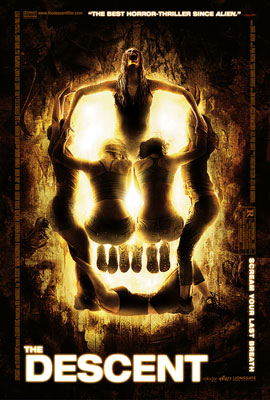
The Descent (2006)


1 hr. 39 min.
R for strong violence/gore and language.
written by: Neil Marshall
produced by: Christian Colson
directed by: Neil Marshall

I made sure I watched this movie in the middle of an afternoon instead of late at night. I knew going in that it could be the type of movie that would send me to bed with the heebie jeebies. The latest trend in suspense and horror movies has not excited me in the least. All I see are countless ripoffs, remakes, and regurgitations of classic and mediocre movies that have already been done. If anything, I've been quite disappointed and disinterested in the popularity and apparent demand for various films depicting graphic decapitations, dismemberment, and mutilations. Thing is, I do like a good scare. I'm more of a "less-is-more" kinda guy. I don't need to see it all to be freaked out but I'll occasionally handle me some gore as long as the plot seems decent enough. Then I remembered this movie that originally came out in the U.K. in 2005 and here in the states in 2006.

One year after a tragic accident, three adventurous girlfriends meet up again to continue their outdoor thrill-seeking ways in a remote part of the Appalachian Mountains for a caving trip. Sarah (Shauna Macdonald), whose life is shattered by the accident, and her friend, Beth (Alex Reid) meet up with their headstrong friend, Juno (Natalie Mendoza) at a cabin outside of their destination. As the unelected leader of the group, Juno has planned out their trip in an effort for them to help Sarah take hold of her life again. At the cabin, they are joined by Juno's young risk-taking protégé, Holly (Nora-Jane Noone), and two sisters, doctor-in-training Sam (MyAnna Buring) and thrill-seeking Rebecca (Saskia Mulder). After spending the night getting to know each other and reminiscing, they drive to the caves the next morning and begin their exploration.

As they spelunk their way deep below the surface of certainty, these six women are faced with facing the unknown below. Disaster strikes when a cave-in blocks their route back to the surface. The girls soon learn that, a misguided effort to bring the group closer together, Juno has brought them to an unexplored cave in the spirit of "claiming it" for themselves. Therefore, no one knows where they are to come rescue them. The group splinters off and each push on, hoping for another exit. They make their way through suffocating crevices as they burrow their to the next unknown cavern. Then, something starts stalking them, crawling around the crevices, blind eyes alive with hunger, toothy maws desperate for human food. As secrets from Sarah and Juno's past percolate below the surface, the threat inside the cave grows frightening – and fatal. It will take everything the ladies have to survive this "Descent" into darkness...and death.

This film is beautifully photographed, loaded with iconic images, and blessed with a level of believability that barely ever ebbs, it's is a well made genre effort. Indeed, it is truly the reference-packed horror highlight reel its director Neil Marshall intended it to be. I had never even heard of the guy and then after reading up on him I see how he has loaded the film with horror favorite homages, from "Deliverance" and "Carrie" to "Aliens" and "The Shining", the British filmmaker, equally famous for his werewolf riff "Dog Soldiers", has crafted an original take on an old formula. Seasoned fear fans will recognize the old dark house motif rather easily, since the vast majority of the movie takes place in a labyrinthine set of caves as perfectly pitch black as a satanic mass. Add in some unspeakably nasty creatures, an overriding sense of foreboding, and some increasing bad blood between the characters, and you've got a recipe for a wonderfully evocative motion picture macabre. Oddly enough, it's an overall atmosphere and ambiance that didn't hit off apparently in theaters. It''s obvious Marshall only meant to give a overall sketch of his adventure gals, I'm sure the quick clip dimensions got lost in all the expansive big screens. Similarly, the director also wanted to push the limits of shadows. He purposefully made the movie as lightless as possible, hoping this would render the suspense more palatable. Unfortunately, the energy saving measures of some theaters rendered the scenes unwatchable.


Shauna MacDonald in Lionsgate Films' The Descent


That's why this works best at home on DVD, especially in a reconfigured print that has much of the arterial spray – and a major subplot – intact. At home, the film finally delivers with the subtlety of certain sequences reborn, and the geyser-like gush of blood filling many of the previous R-rated killings, Marshall's movie shifts from an exercise in dread to a fully realized gruefest. Indeed, the faint of heart should be prepared for the girl's last stand act in all it's gruesome-ness. Although I never saw the U.S cut of this film I can't imagine a more intense, claustrophobic, full-realized horror film than this. With this unrated cut maintaining the original ending (the "non-happy" UK version) and upping the visual amperage a tad, what was seemingly a single light shining into a big black void experience has been rendered far more frightening with just the slightest hints of approaching horror featured alone the fringes of the action. When you add in the increased character dynamic and the lush look of the landscapes, you get a far more compelling cinematic situation.

This movie couldn't be successful without this cast. Instead of going the American route and casting "hotties" to run around half-nekkid, we're given actors that fully realize the headstrong and passionate characters written for them. It's refreshing to see these basically average albeit physically capable women, that could easily be women that you or I could know, take an adventure that tests their friendships, sanity, and survival instincts. I also liked that I felt for these characters but I never really got attached to them. In fact, I started getting suspicious of some of them. To me, that means the actors and the director are succeeding in what they set out to do.

There is real artistry in what Marshall has managed here and I'm lad my viewing was alone at home. Viewed as an inventive psychological thriller, an old dark house spook show, or a post-modern meditation on man vs. nature and the unnatural, "The Descent" deserves the attention of any serious scare fan. While far from a masterpiece, it definitely represents an ingenious and distinctive deviation from your standard horror film.


Special Features:


The DVD has all the necessary bonus features that any fan wishes for – beginning with two full length audio commentaries. First, director Marshall with several of his crew members (including producer Christian Colson, editor Jon Harris, assistant editor Tina Richardson and Production Designer Simon Bowles), and the second features Marshall again with almost all of the female cast (Nora Jane "Holly" Noone, Saskia "Rebecca" Mulder, MyAnna "Sam" Buring, Shauna "Sarah" McDonald, and Alex "Beth" Reid). Making an effort not to repeat himself between the two discussions, the director does a good job of guiding the others through all their anecdotes and insights. The second conversation, given over to lots of jokes and good natured ribbing lets the girls explain their approach to the story. The more "serious" commentary deals with many of the production problems, and how CGI was used to enhance, not replace, the physical feel of the effects. I skimmed through both tracks and from what are heard...they were great terrific and do a good job of filling in details about the film's unique dynamic. Similarly, a 41 minute "Beneath" the Scenes featurette shows the in-studio set construction, the evolution of the crawlers design, and the occasional emergency that required an inventive solution (like the use of a bathtub to create a small pond). In this feature, I found it funny that the director and crew were calling the film "Six Chicks with Picks" during production.


We're also treated to a series of outtakes (mostly hilarious bloopers and practical jokes played on the cast and crew), deleted and extended scenes (almost all dealing with the relationship between the girls prior to entering the cave), a collection of stills and a set of cast and crew biographies. Perhaps the most interesting added feature though is something called "DescENDING" and as the name implies, it deals with the alternative cut of the film. When it first arrived in the UK in 2005, Marshall had created a very dark, disturbing finale that offered little hope for the characters. When it was tested in America, the scene did quite well. But when a truncated version was shown, stopping at a crucial point and suggesting some possibility of optimism for the lead, US audiences really approved. Lionsgate demanded the change, and that's what arrived in theaters back in August. Marshall is on hand to describe the situation, and this nine minute interview offers some interesting facts about the film's many influences (including Terry Gilliam's "Brazil"?) and his feelings about the ending controversy. It's a nice addition to what is already a well supplemented DVD package.


The Skinny:

  • The cast members were taken to a rock-climbing center in Derbyshire to help prepare them for filming.
  • The appearance of the creatures was kept secret from the cast members until the first scene in which they encounter them was filmed. When the cast were finally filming the scene where the girls encounter the crawlers, the girls were genuinely scared and screamed the building down, running off set and laughing.
  • The cave drawings featured rhinoceros. Rhinoceros went extinct in North America during the Pliocene which ended 1.8 million yrs ago. Also, Petroglyphs (cave drawings) have only been found from about 10,000 years ago.
  • The Number 30 bus destroyed at Tavistock Square during the terrorist bombings of London in July 2005 had been carrying a placard on the side advertising the film. The placard featured a bloodied Shauna Macdonald staring out of darkness, and quotes from several positive reviews of the film. Famously, as seen in Mario Rosenberg's award nominated photos of the scene, the half of the placard left undamaged by the blast read "Outright Terror, Bold and Brilliant," a quote from a review by Total Film magazine. Several commentators, including writers for Variety and The Times, remarked on this unfortunate coincidence. Three of the four bombs detonated that day specifically targeted the London Underground transport system, leaving many victims trapped underground for several hours. There were initially concerns that the film, due for release the next day, might have to be delayed for reasons of sensitivity but ultimately Pathé chose to release the film with a slightly retooled marketing campaign. The US promotional campaign, managed by Lionsgate Films, is significantly different from the original European one.
  • This film's North American Poster Art is borrowed from a portrait photograph by Philippe Halsman of Salvador Dali, entitled Salvador Dali In Voluptate Mors. (The photo itself was inspired by surrealist Dali's gouache Female Bodies as a Skull painting) This same imagery was also used for the Silence Of The Lambs poster.


Comingsoon.net's interview with director Neil Marshall, click here
deadcentral.com's interview with director Neil Marshall, click here.

Wednesday, February 7, 2007

REEL REVIEW: Letters from Iwo Jima (2006) ****

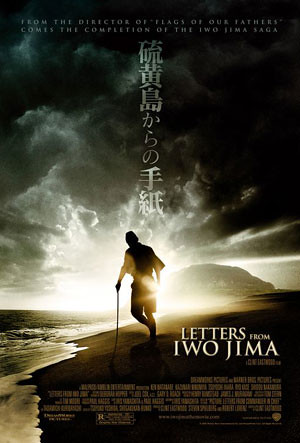
Letters from Iwo Jima (2006) poster


R for graphic war violence.
2 hrs. 21 min.

written by: Iris Yamashita & Paul Haggis
produced by: Clint Eastwood, Robert Lorenz & Steven Spielberg
directed by: Clint Eastwood


"The life of your father is just like a lamp before the wind."

- a line from a letter written by Lt. Kuribayashi to his son, Taro from Iwo Jima


The only thing I knew about the battle for the occupation of the island of Iwo Jima was the random iconic photograph taken by the late Joe Rosenthal. You know the one. Five American soldiers raised a U.S. flag atop Mount Suribachi on February 24 1945, four days after Marines had landed on the Japanese volcanic island. The black & white photograph showed an assured American history or at least as much as a victory can be portrayed through one photograph. But who were those soldiers lifting that flag and who were the soldiers that defended that island?

These two questions are answered in director Clint Eastwood's two recent films. The first film, "Flags of our Fathers" was released in the U.S. on October 20, 2006 and despite getting decent reviews, did not draw too many people. While "Flags" deals with the lives of the three surviving soldiers from that infamous photo and the media frenzy that followed, "Letters from Iwo Jima" (released in Japan on December 9th and in the U.S. on January 12th) is the story of those unseen Japanese soldiers that tried to hold their land so the Allied forces would not turn it into a base from which they could attack their homeland. The title of the film is derived from the source and inspiration for the story. While making "Flags", Eastwood found out about the piles of unread letters that were discovered by Japanese archivists buried in the caves the soldiers had burrowed in the mountainside. These letters turn out to be the actual framework for this little-known epic.

The best way to handle a war movie is to pick a character or two and take the audience on the same revealing journey as the grim realities of war unfold before them. Eastwood succeeds in doing just that while evoking real emotion at the same time. Although every camera ankle and color saturation is deliberate, no emotional heart-tugging is forced here. The viewer isn't forced to feel for these soldiers or their situation by some syrupy scene or dialogue, but rather the overall poetic delivery of the mood and of the soldiers vivid memories as they write their letters.

The story begins with a young soldier named Saigo (Kazunari Ninomiya), a private in the Imperial Japanese Army, begrudgingly digging trenches on the beach; as far as he is concerned, the Americans can have the island. He's a baker who was forced to leave his wife and unborn child to go to Iwo Jima, he can't see the point in defending a lonely rock so far from home. At the same time, Lt. General Tadamichi Kuribayashi (Ken Watanabe) flies to Iwo Jima via camouflaged plane and meets the other commanders. He sets out on foot with his aide to study the island firsthand and come up with a plan to defend the island against the American invasion. At the same time, the American fleet, stationed at Saipan, is preparing to go north to Iwo Jima. Although there are other characters focused upon, these two soldiers on opposite ends of the ranking scale, have the most interesting, most relatable stories to tell.


When Kuribayashi arrives on the beach, notices his soldiers digging trenches on the beach and orders them to stop; instead, he tells them to burrow fortifications in the higher grounds. He sees Saigo being beaten by his superior officer for uttering unpatriotic statements. He stops the beating, establishing a connection between himself and the lowest man in his ranks and starting a pattern for their future encounters. Saigo is saddled with a duty he didn't ask for, and the General sees it as his counter duty to make sure he gets as many of his men off of Iwo Jima alive as possible. This doesn't sit well with most of the other officers in his employ, who would rather see everyone die with honor than retreat. They don't see the value of living to fight another day.


Ken Watanabe as General Kuribayashi in Warner Bros. Pictures' Letters From Iwo Jima


Characterization is one of the many aspects of this film that was quite refreshing to me. Kuribayashi is portrayed as a man who leads with a quiet, gentle force that is not respected right away by his fellow officers but we see it and so do the lower ranking runts under him. He sees his men as men, not just single-minded, suicide soldiers. We see a lamenting heart as he writes his letters to his son on the mainland telling him of their dire conditions. One of stand-out characters was Officer Nishi (Tsuyoshi Ihara), a tank commander and equestrian Olympic Gold Medalist from the 1932 Los Angeles Olympics. He's and old friend of Kuribayashi and one of his only confidants. Nishi tells him that the prospect of Imperial Japanese Navy sending support and helping them defend the island is pretty bleak seeing that the Japanese Combined Fleet was destroyed at the Battle of Saipan. Upon hearing this, Kuribayashi reflects on his plan to defend Iwo Jima with no outside support, and soon comes to the conclusion that Iwo Jima will be defended until the death.

The rest of the story deals with the varying actions of these soldiers who know they are left for dead on this island. Some soldiers accept their fate and make the difficult decision that it is better to commit suicide then suffer the shame of defeat. Others fight to the death instead of taking their own lives as a more noble way of going out. With either outcome, we see the pressure of war thrust upon these men as a couple of them even opt to surrender. This is the first World War II film that I've seen where the Japanese are depicted as human instead of one-dimensional. There are the old Bugs Bunny cartoons and John Wayne war movies that depict the Japanese as frothing mad kamikaze nutjobs but here we see they have the same fears, doubts, courage and heartbreak as anyone else.


Tsuyoshi Ihara as Baron Nishi in Warner Bros. Pictures' Letters From Iwo Jima

One of my favorite scenes is when Nishi and his troops take in a wounded American soldier. His troops are apprehensive at first due to their dwindling medical supplies. Nishi orders them to take care of him, to treat his wounds and tend to him. Despite their efforts, the American dies, and he eulogizes him by reading a letter the American received from his mother. It's a moving moment as all of the soldiers within earshot slowly pay closer attention to the loving and comforting words of this enemy's mother. They realize that this soldier is not so unlike themselves. He too is loved and is thought of by someone far far away and maybe this is how they will look one day....dead with their loved ones off in the distance somewhere wondering when they'll return. It's scenes like this, shot simply, that are effective without getting overly sentimental.

The talented cast of this film is made up almost entirely of Japanese actors speaking in their native tongue. I'm not gonna go into the specifics of what great actor portrayed which great character here because, although these minor characters are integral, not all of them are as fleshed out and crucial to the story as the two main characters the screenwriters focus on. We do see some of the American soldiers, but the interactions between the two sides on a one-on-one level are limited. None of these soldiers are characters from "Flags", and I applaud Eastwood for avoiding any cameos or convenient crossovers that coulda been done. After all, It woulda been a lil too jarring to see Ryan Phillipe whiz by, taking the viewer outta the film's perspective.

Watanabe is a remarkable screen presence. He reminds me of a classic matinee idol, and Eastwood has made up for Hollywood's indiscretions toward this fine actor by handing him the meatiest role of the movie. His Kuribayashi is an intelligent leader who sees value in strategic planning only if the human factor is given the utmost importance. The story shows how he spent some time in America which make some comrades suspicious, it actually gives him greater insight into what he is up against. Watanabe gives the character the warmth and gravitas with equal measure. The film shows the Kuribayashi doodling in a sketchpad while bombs drop all around, shaking the walls of the underground tunnels the Japanese are holed up in, and it's actually this picture journal that forms the basis of first-time screenwriter Iris Yamashita's script.


Kazunari Ninomiya as Saigo in Warner Bros. Pictures' Letters From Iwo Jima


Perhaps to match the subject matter, Eastwood has given the film a gray, almost sepia tint. The air around everyone looks as if it is heavy with clouds, and it makes it impossible to forget the fate that hangs over them. Yet, the movie never grows so heavy that it buckles under its own furrowed brow. This is because the director, like the General whose story he is telling, never forgets that his movie is about real people. Sure, it's a war movie with plenty of fighting, often with very gory results, but Eastwood makes sure he has time to show quiet character-building moments that matter. Like Kuribayashi sharing a drink with a sympathetic ally Nishi and Saigo swapping stories with his buddies, and even the soldiers laughing and speculating on the strange behavior of their superiors. These scenes break any preconceived stereotype we might have, not just of the Japanese soldiers but of WWII in general. No longer is it possible to portray it as a simplistic conflict where the good side was very, very good and the bad side so very, very bad. Rather, war is complex, dirty, and for the men who do the fighting, it rarely has the clear outcome history memorializes.

By stepping out of the normal boundaries of a WWII movie, Eastwood has found something new to say on the subject. For those out there who ask why we need another movie about the conflict....see this movie. It proves there is still much we have to learn, still stories that haven't been told. That it's done so well and by one of the finest and most daring filmmakers we have is just a bonus.


Either of Eastwood's films can be seen on its own without watching the other. I plan on finally seeing "Flags" when it comes out this week in a bare-bones DVD (I'm sure a special edition will come out once this film, up for a Best Picture Oscar, is released). You'd think cuz I was an extra in "Flags" I woulda got free tiks, but, ah well. But, I have a feelin' "Flags" may suffer a lil in my eventual review because I can certainly attest that this film is a masterpiece. I dunno how many people are wanting to see this movie, I'm hoping everyone cuz that's who I'd recommend it to. This harrowing "other side of the story" not only honors the memory of these soldiers but manages to see beyond any genre as it gives a quiet intimacy and beauty to a grim and bloody battle.


The Skinny:


  • The film was originally entitled "Red Sun, Black Sand."
  • Although the film is set in Japan, it was filmed primarily in Barstow and Bakersfield in California. Filming in California wrapped on April 8, and the cast and crew then headed back to the studio for more scenes before a quick 1-day trip to Iwo Jima for some on location shots. The Japan Maritime Self-Defense Force (JMSDF) operates a naval air base in the island, which is used by the United States Navy for operations such as nighttime carrier landing practice. Civilian access to the island is restricted to those attending memorial services for American and Japanese fallen soldiers. The location was used under a special permission from the Tokyo Metropolitan Government.
  • Filming finally wrapped in late 2006.
  • Kazunari Ninomiya (Saigo) is better known as a pop music star, part of the group Arashi. Letters is only his fourth motion picture and the first aimed at an international audience.
  • Although they were filmed back to back, none of the cast from this film appears in "Flags of Our Fathers", and vice versa. None of the cast members even met each other from each film. The only cast member to be in both films comes in the flame throwing figure of Chuck Lindberg (Allasandro Maestrobuono). He advances on a bunker with a flamethrower. The members of the casts of both films have met, though never officially presented together, as there many commonalities between the casts in the acting community.
  • Watanabe read actual letters sent by Imperial Japanese Army Gen. Tadamichi Kuribayashi to his family from Iwo Jima while preparing for his role. Eastwood has always surrounded himself with the same talented and resourceful film crew in his film directing. He has kept the same cinematogrpaher (Tom Stern), editors (Joel Cox & Gary Roach), production designer (Henry Bumstead), and casting director (Phyllis Huffman). This would be the last film Eastwood would work on with Bumstead (died on May 24, 2006) and Huffman (died on March, 2, 2006).

About Me

My photo
Believer. Brother. Son. Nephew. Cousin. Friend. Husband. Father. Colleague. Student. Teacher. Illustrator. Actor. Director. Singer. Improviser. Listener. Observer. Passenger. Driver. Tourist. Traveller. Imaginative. Resilient.